There’s a growing fear that artificial intelligence (AI) is coming for everyone’s job. Scroll through social media for five minutes and you’ll probably find someone claiming that writers, designers, developers, marketers, teachers, or even doctors are all about to become obsolete.
And honestly? It’s not irrational to worry.
Technology has always changed the way humans work. Factory machines replaced certain types of manual labour. Self-checkouts reduced some retail roles. Automation transformed manufacturing. So it would be naive to pretend AI won’t affect jobs too.
But there’s an important difference between changing work and eliminating humans entirely.
History shows us that humans adapt.

Once upon a time, people would have thought it impossible to travel from the countryside to London in a hurtling metal tube in just a few hours. The industrial revolution transformed transport, communication, farming and manufacturing in ways people could barely imagine.
AI is another one of those moments.
The key question isn’t: “Will AI change jobs?”
It absolutely will.
The real question is: “Will humans still matter?”
And the answer, at least for the foreseeable future, is yes.
AI Still Needs Humans
One thing people often forget is that AI doesn’t actually understand the world in the way humans do. It just predicts patterns. That’s incredibly powerful, but it also means AI depends heavily on human input, human judgement and human correction.
Even now, AI systems regularly:
We’ve all seen the examples:
That’s because AI still needs humans to:
Without humans, AI quickly becomes a loop of recycled content feeding itself.
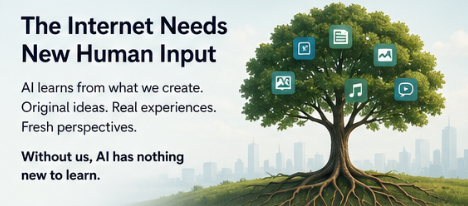
The Internet Problem Nobody Talks About
AI models are trained on human-created content.
That means they need:
and everyday people creating new information
If humans stop producing original work, AI has nothing fresh to learn from. Eventually, it starts regurgitating recycled versions of recycled content until the quality declines and the line between fact and fiction becomes harder to see.
Ironically, the more AI grows, the more valuable authentic human knowledge may become.
Real expertise matters.
Real experience matters.
Original thought matters.

Some Jobs Will Change, But New Ones Will Appear
Every major technological shift creates panic at first. When machines entered factories, many feared there would be no work left at all. Instead, jobs changed. Some disappeared, but entirely new industries emerged around them.
The same thing is likely to happen with AI.
Certain repetitive tasks may become automated:
But new roles are already appearing:
Most jobs probably won’t vanish overnight. Instead, many people will end up working with AI rather than being replaced by it.
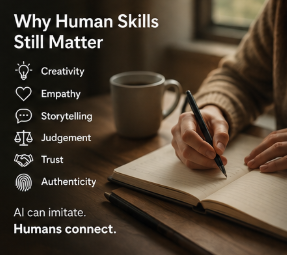
Why Creative and Human Skills Still Matter
AI can imitate style and structure, but authenticity is much harder to fake. People still connect with personality, humour, lived experience, storytelling, empathy, trust, and human perspective. That’s why creators who build genuine audiences are likely to remain valuable.
A blog written by someone with real experience often feels different from something generated purely by AI. Readers can tell when there’s actual insight behind the words.
The same applies across industries; clients trust people, patients trust doctors, customers trust brands and teams trust leaders. Human relationships are still incredibly important.
So… Should People Be Worried?
A little caution is healthy. Ignoring AI completely would be a mistake, especially in digital industries where tools are improving rapidly, but panic probably isn’t helpful either.
We are nowhere near a world where AI independently replaces all human contribution. Right now, the people most at risk are often those who refuse to adapt at all.

How To Make Yourself Harder To Replace
Instead of asking: “Will AI take my job?” it may be better to ask: “How do I become someone AI can’t easily replace?”
Some ways to do that:
The workers who thrive are usually the ones who evolve alongside technology
AI is going to change the world. There’s no point pretending otherwise. Some jobs will disappear, some roles will shrink, some industries will transform completely.
But humans have gone through technological revolutions before and every time, we find new ways to create, work, adapt and contribute.
AI isn’t replacing humanity, it’s just becoming another tool, albeit a very powerful one. Humans will learn to work with it, just like we did with machines, computers and the internet itself.
