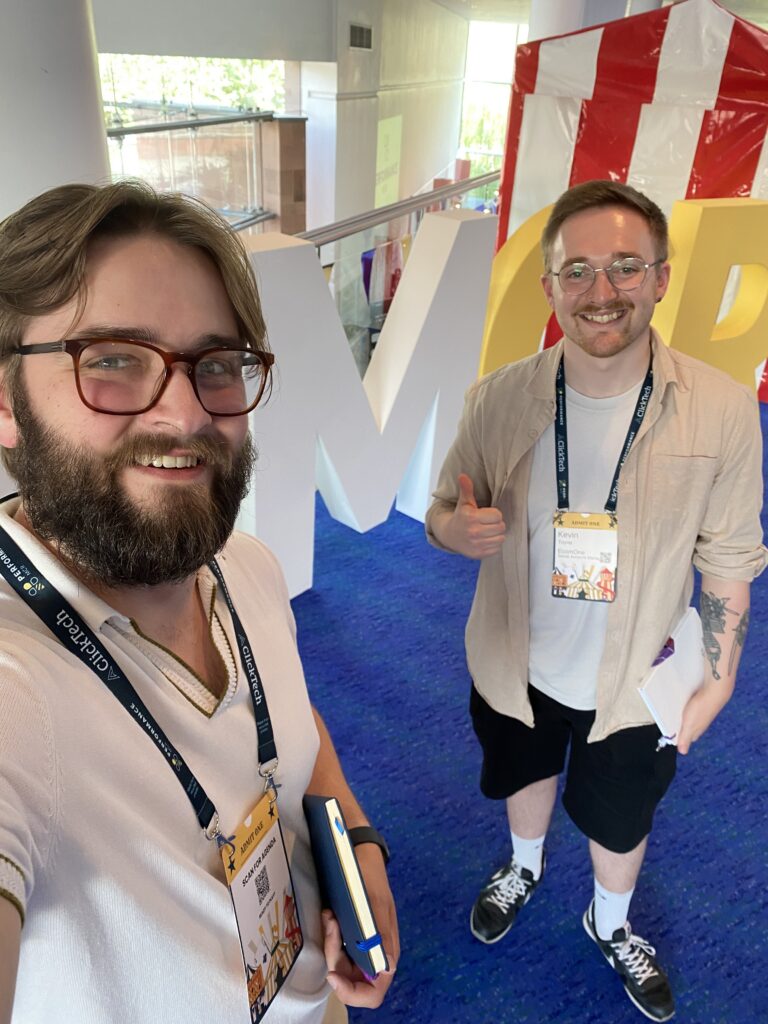
Our social team recently attended a Performance Marketing conference and some of the best insights come from a room full of marketers comparing notes on what’s actually working. Between our two sets of session notes, ten themes stood out. Some challenge long-held PPC habits, others reframe how we think about creative and AI search. All of them are worth acting on.
Table of Contents
- Understanding the Client Is Still the Job
- Ads That Engage, Not Just Sell
- AI Search Is Problem-Led, Not Spec-Led
- Creative Diversification Means Actually Diversifying
- Play Without a Guaranteed Payoff
- Landing Pages Should Continue the Conversation
- Be the Underdog and Exploit the Gaps
- Targeting Is Probability, Not Precision

Understanding the Client Is Still the Job
However many structural advantages an agency has over an in-house team, proximity to the business will always matter. As Matt Beswick put it in The In-House PPCer: How to Think Like the Clients You Serve, you have to genuinely understand a client’s business, what success looks like for them, and how non-sale events tie back into that success. For many retailers, this understanding is the difference between a campaign that works and one that misses the point entirely.
Ads That Engage, Not Just Sell
Callum Devine’s The Meta Ads Playbook Brands Refuse to Follow raised a question worth sitting with: is it time to build ads that engage rather than sell? Meta wants users to stay on the platform, so content that engages without disrupting someone’s scroll might actually improve campaign performance rather than working against it.
The same session also highlighted the strength of partnership ads on Meta, regardless of influencer size, CPA reports point to a 20–50% average drop in cost-per-acquisition. It’s a strong reminder that partnership content can outperform traditional ad formats even without big-name creators attached.

AI Search Is Problem-Led, Not Spec-Led
One of the more thought-provoking sessions, AI Readiness: What Brands Are Doing, Delaying and Doubting, featuring Divya Patel (Glass Atlas), Camilla Tress (Oliver Bonas), Martin Corcoran (Summit), and Jason McIlvenny (Silentnight), made a simple but important point: AI search responds to problems, not specifications. Someone searching “I have a bad back, I need a new bed” isn’t going to be served based on a firmness index. Brands need to write content and product descriptions that speak to the customer’s actual issue, not just the technical spec sheet.
Creative Diversification Means Actually Diversifying
Ellie McGuigan’s Creative Isn’t the New Targeting. Difference Is. landed as one of the most repeated points across both sets of notes and for good reason. Producing ten ads with the same ratio, image, and format, differentiated only by a slightly different CTA, isn’t creative diversification. It’s the same ad ten times over. Real diversification requires proper process built into the design workflow from the start and the stakes are high: 56% of auction outcomes are attributed to creativity alone.

Play Without a Guaranteed Payoff
Kat Sale’s Why the Best Marketers Still Play offered a challenge to anyone playing it safe: the best marketers play, and playing often gets you nowhere and that’s fine. Learning to experiment and try things not because you’re confident they’ll work, but simply to see what happens, is how unconventional wins get found.
Landing Pages Should Continue the Conversation
Dean Kadi’s Stop Testing Ads, Start Testing Journeys made the case that landing pages are too often an afterthought. They should always continue the conversation that the ad started, a simple principle, but one that’s frequently overlooked in favor of optimising the ad itself.
Be the Underdog and Exploit the Gaps
Taylor Housden’s The £100K Underdog: How We Took on E.ON and Octopus Energy (and Won) offered a practical playbook for smaller budgets facing bigger competitors: run a competitor analysis that identifies the cracks bigger players are overlooking and exploit them. Use what they don’t. Lean into being the underdog rather than trying to outspend the competition.

Targeting Is Probability, Not Precision
Tom Coad’s session, I Don’t Know Who Needs to Hear This, But I Struggle with Targeting, offered a refreshingly honest take: targeting is probability under pressure, not precision engineering. Over-engineering targeting setups is often the enemy of performance and sometimes the answer really is to keep it simple.
The Bottom Line
Across every session, a common thread emerges: marketing is getting less about mechanical precision and more about genuine understanding of clients, of customers’ real problems, and of what actually earns attention without disrupting it.
Whether it’s writing for how people search, diversifying creative properly, or simply being willing to test things that might not work, the throughline is the same: real insight comes from proximity, experimentation, and a willingness to keep questioning default habits.
If you are struggling to generate a profitable return with your paid ads, let’s have a chat!
